WHY THE DEBT CRISIS IS GOING ON AND ON?
Given the debt crisis has been at unrepayable levels for several years now – we also have to ask why it hasn’t been resolved like previous debt crises in other regions or indeed in Africa?
The current African debt crisis is the worst in history, not because of what was borrowed but because so little is being done about it by the creditors and those that regulate the international system.
So why is the crisis going on and on? There are four main questions to consider:
1) Why Isn’t the IMF Supporting Debt Cancellation?
Why haven’t the IMF and others stepped in to end the crisis? Why didn’t the IMF force rich countries to rectify the consequences of their pandemic policies? Why haven’t the IMF supported countries to declare bankruptcy – like many of the US President’s businesses have over the years?
Even though lower income countries have to pay much higher interest rates on loans, if there is a problem the creditors who lent the money often don’t lose out. If crops fail, or an investment doesn’t succeed then creditors would lose money on the failed business investment.
For many African countries what happens is that the IMF comes in and bails the creditors out (it is called a country bail out, but the truth is overseas creditors are the ones who are paid by the IMF).
The country then repays the IMF over a longer time period, which means another generation of children suffer.
So why are the IMF so focused on paying off creditors rather than pushing for debt cancellation when an investment fails and loans become unpayable?
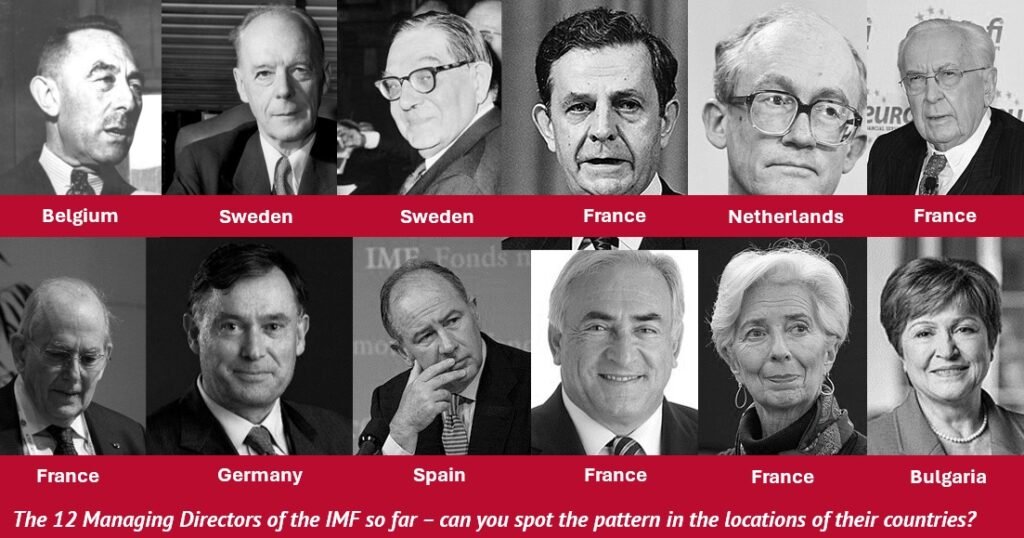
The location of these creditors and the make-up of the IMF’s shareholders are important factors.
The IMF is controlled by the world’s richest countries, as it has been since it was founded in colonial times. All 48 countries in sub-Saharan Africa have less votes than the UK and Belgium for example. [1]
This is unjust and affects how and for whom the IMF is run. For example, in 78 years the Managing Director of the IMF has always been selected by European countries (as part of the West’s ‘gentleman’s agreement’ [2] where the US selects the World Bank President [3]).
If you look at the 12 Managing Directors of the IMF so far you can see that the European countries have always decided to choose a Managing Director who is …… a European.
This control by the richest Western countries means too often the IMF engages with debt problems from the perspective of looking after creditors rather than truly helping the country in crisis.
Ensuring creditors are repaid as much as possible is the priority and instead of full cancellation that the country needs, most of the debt is left in place.
Under pressure African finance ministers and central banks are understandably keen to avoid ‘defaults’ but it is not in the countries long term interest to indebt the next generation to long term IMF loans.
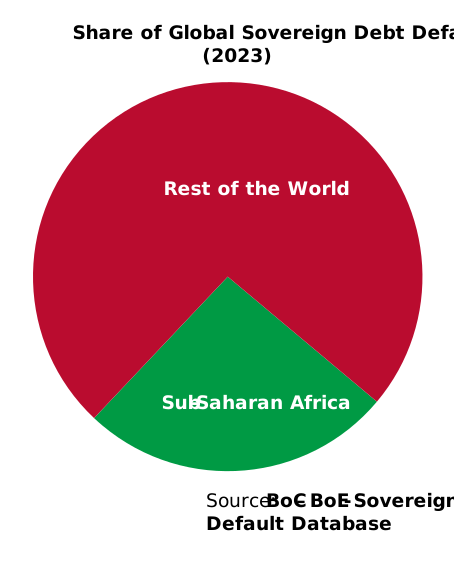
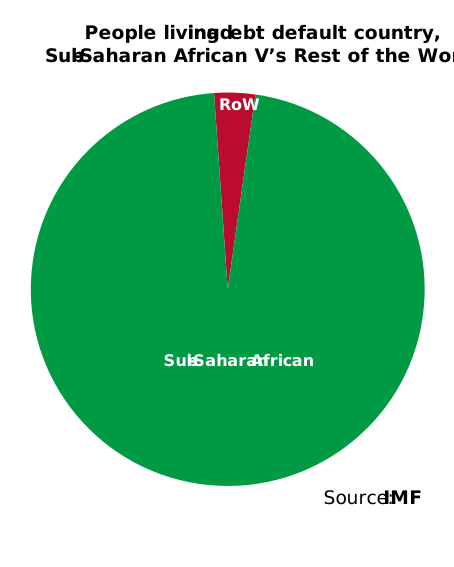
Other parts of the world default on bigger sums, since 2015 sub-Saharan African defaults have only been between 19-26% of the global debt default total [4] despite 97% of the children in the world living in a country in debt distress being African. [5]
In fact, each year since 2015 just three countries, Russia, Venezuela and Iraq have defaulted on more debt than all of sub-Saharan Africa combined. [6]
African governments come under such pressure as their economies are small and debtors can also threaten other consequences, but globally speaking, debt defaults were much higher in previous decades.
Debt defaults were 6.4% of global GNI in 1990 yet now during the ‘worst debt crisis on record’ global defaults are around 0.5% of global GNI , because the ‘scale of defaults has fallen substantially’. [7]
As extreme poverty and malnutrition soars, as the IMF focus on paying off creditors and in the absence of any meaningful debt cancellation from the richer countries that caused this crisis, a different pan-African approach to reject debt slavery might be needed.
IMF Sovereignty?
Another factor in the IMF’s preference for bailing our creditors rather than cancelling debt can also be the greater power given to the IMF in a ‘bailout’.
Whereas when debt is cancelled the IMF’s involvement is for shorter period, when the Western controlled IMF bails out Western creditors, the IMF can take control of the African government’s budgets for years.
This loss of sovereignty directly undermines democracy and often means harmful conditions by the IMF, including limits on education and other social spending.
An EI, ActionAid and PSI report in 2021 highlighted that “IMF austerity cuts in just 15 countries blocked the recruitment of over three million nurses, teachers and other essential public sector workers, undermining progress on health, education and gender while blocking climate action in some of the world’s poorest countries” [8].
In many respects, the IMF, based in Washington and with a governance controlled by rich countries, simply continues the colonial era trends of governing Africa from outside and for outside interests. It undermines sovereignty and decisions are taken based on what serves the West’s interest not Africa’s.
The situation in this debt crisis is critical, millions have already suffered already and entire countries are at risk. Governments will fall unless action is taken to cancel the debt.
Instead of controlling countries for another generation, the IMF and the rich countries that run it must support a major debt cancellation to reset after the pandemic and the rich country discriminatory response.
Negotiations for cancellation have also been complicated in this crisis because alongside Western countries and the IMF, there are two major new actors in lending to Africa in recent years – China and private companies.
2) What Role Does China Play?
China has been heavily investing in Africa for the last two decades, in some cases helping countries with major infrastructure projects and backing their development. However in many cases they have started to now follow the well trodden path of international exploitation.
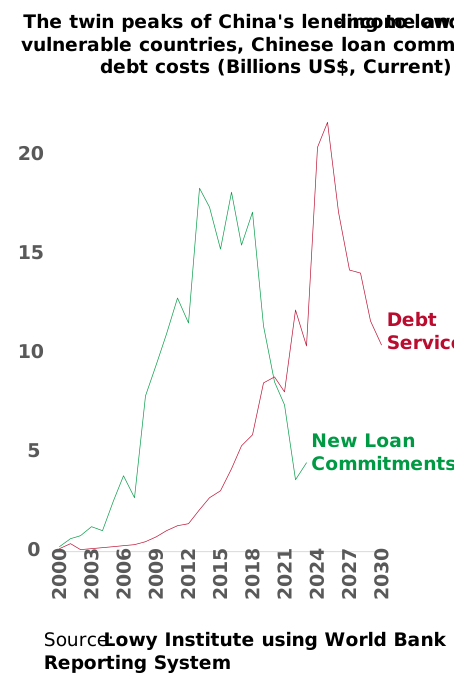
A lot of the expansion has been funded by debt and with repayments skewed into the future this didn’t matter initially but now a lot of it is due – some $20 billion in debt is due to be paid from African countries to China alone in 2025. [9]
It is a colossal sum, that many countries simply can’t afford to pay, especially given the impact of the COVID 19 pandemic on the economic investments which the loans funded.
It is also affected by the lower than market price countries often receive on their natural resources exported to China.
The Chinese government has an opportunity to avoid the mistakes of other colonial powers – they must not use this crisis to force countries into debt slavery for decades to come. Insisting on unrepayable debt will destroy education in Africa, create famines and destabilise governments.
Instead, China should act as any true partner of the continent would, with a people centric approach that recognises the lasting impact of the pandemic, and the scale of the debt crisis makes repayments impossible on this scale and to undertake a one-off cancellation of debts.
The lasting benefits to Africa and China would be transformative, it would demonstrate how China is taking a different path to colonialism and the close connections between the future of young people in China and Africa.
3) Private Company Debt – the new debt slavery?
Alongside the rise of Chinese debt, there has been the less discussed rise in private company debt even though it is a larger volume. As Debt Justice note “Western leaders blame China for debt crises in Africa … The truth is their own banks, asset managers and oil traders are far more responsible but the G7 are letting them off the hook. China took part in the G20’s debt suspension scheme during the pandemic, private lenders did not”. [10]
Private sovereign debt to Africa has trebled in the last 15 years [11].
This has complicated efforts for debt cancellation, particularly in the cases where the companies are being paid in full by the IMF or have dubious motives in the first place.
For example, Glencore, a private company with a shocking track record, is the largest private external creditor to Chad [12]. This gives it undue influence over the government.
Chad is one of a handful of countries helped so far in five long years of the G20’s common framework. But Glencore, held up the debt relief deal eventually agreed by the G20 countries for an entire year in 2022 [13]
At the time Tim Jones, head of policy at Debt Justice, said “The consortium of lenders led by Glencore must be laughing all the way to the bank. They’ve delayed the debt relief process for the last 18 months. During that time the IMF loans have effectively been paying them off. Their reward is to keep being paid off in full”. [14]
A 15 year-old girl in Chad has a 1 in 15 chance of dying from maternity-related causes in her lifetime, a risk almost a thousand times greater than if she lived in Switzerland, where Glencore is based. [15]
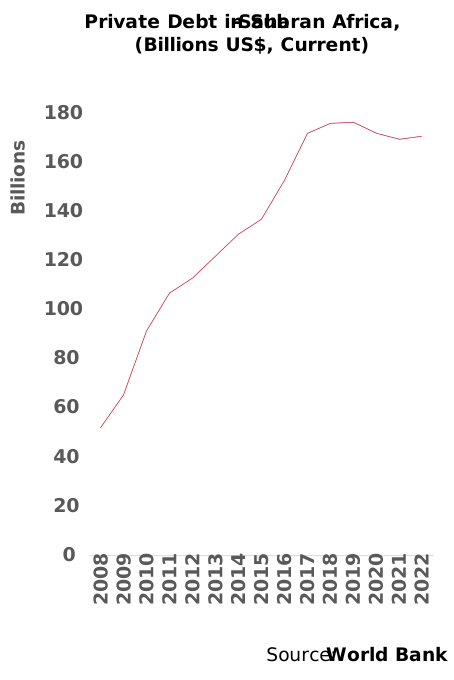
Another major company, Blackrock is the largest known holder of debt in poorer countries and is the largest private bondholder in Zambia.[16] It refused a request to suspend debt repayments in 2020 at the height of the pandemic.
Though it finally relented to some of the pressure in March 2024, much of the debt remains and the millions of Zambian children who were forced out of school in those four long years will never get their childhood back.
This corporate control of debt also raises concerns of African government autonomy as it gives those companies great control when negotiating other contracts with the same countries or when those countries try to act on tax injustice and profit shifting by companies like Glencore.
Along with the private sector debt Blackrock is buying up, Friends of the Earth assessed that BlackRock owns more oil, gas, and thermal coal reserves than any other investment management company with total reserves amounting to 30 percent of total energy-related emissions from 2017 [17].
Debt for years has been used by other countries to control and influence African countries. The then President of Burkina Faso Thomas Sankara said “Debt is a cleverly managed reconquest of Africa” [18] as long ago as the 1980s.
It should not be a surprise if companies, many larger than most African countries, now try to have the same control.
This is why a sovereign debt mechanism is so essential; companies with mining interests and rogue debt traders cannot be allowed to hold bankrupt countries to ransom or to trap countries in their perpetual debt. An age of corporate debt slavery cannot be forced on Africa.
Unlike six of the current US President’s businesses [19] , countries can not currently file for bankruptcy. In fact, it is the courts in the US and UK that determine the enforcement of most international debt, for example with “international bond contracts, 99% are governed by English or New York law.” [20]
This creates a huge imbalance as the courts tend towards the interests of the creditor over a country in Africa even when the creditor is a vulture fund.[21] As the African Development Bank Group notes historically “Twenty-five judgments in favour of vulture funds so far have yielded nearly US$1 billion” with 72% of the judgements against African countries. [22]
There are a number of examples of debt being borrowed without the knowledge of that country’s parliament and even of loans paid straight to sham companies. [23]
In these cases, the debt cannot be passed onto the people of a country and any fair system would ensure lenders take responsibility for poor lending, as they already do with company loans. Indeed the companies who now own so much of Africa’s debt are allowed to file for bankruptcy if they ever needed it, the countries whose debt they hold cannot.
The system has to change.
4) What about the G20?
Whilst private sector companies have made a mockery of the supposed power of the G20, the G20’s lack of real commitment is also to blame. Contrast the scale and speed of action for relieving the G20’s domestic problems during the Covid-19 pandemic and their incredible inaction on developing countries’ biggest debt crisis in history [24].
Even though at least $12 trillion was spent by the G7 countries alone [25], insufficient resources were earmarked for the G20 debt framework when it was announced in November 2020.
In the Riyadh Summit Rising to the Challenge Together declaration G20 leaders recognised the huge scale of the crisis but then only noted action ‘may’ be needed for some countries “Given the scale of the COVID-19 crisis, the significant debt vulnerabilities and deteriorating outlook in many low-income countries, we recognize that debt treatments beyond the DSSI may be required on a case-by-case basis” [26]
The G20 leaders also boasted “We have mobilized resources to address the immediate financing needs in global health to support the research, development, manufacturing, and distribution of safe and effective COVID-19 diagnostics, therapeutics and vaccines. We will spare no effort to ensure their affordable and equitable access for all people” yet a year later we had vaccine Apartheid and sub-Saharan debt servicing payments had rocketed ($50 billion higher by 2024 [27]). The ‘we’ in this case obviously excluded Africa.
Instead of helping all the countries who were in a debt crisis, the G20 mechanism has incredibly slowly focussed on a handful of countries and even then it has left so much of the debt in place the countries are still in crisis.
After protracted negotiations, only the more unpayable debt which was unlikely to ever be repaid has been cancelled by creditors and repayments are still very high. “The six countries that recently went through debt restructuring [are still] paying an average of over 20% of government revenue on external debt service”[28]
It is a clear demonstration of the failure of the G20 to act in anyone’s interests but their own.
In April 2024, the World Bank’s chief economist highlighted how “there has not been a single dollar of debt relief from the common framework” [29].
The sidelining of the United Nations in the pandemic response and since by the G20 , has seen the interests of low-income countries being left behind by the world. Nowhere is this more evident than the woeful response to the debt crisis in Africa.
In any agreement that considered the needs of people outside the G20, debt for low‑income countries would have been cancelled during the COVID crisis. This would have cost less than one month of the emergency funding spent in rich countries that year. [30] However, instead the G20 (temporarily) suspended interest payments, [31] so the debt continued to build up.
The G20 is hosted by South Africa in 2025, and the Africa Union was finally awarded a full seat at the G20 under India’s leadership in 2023. However Africa is still overwhelmingly under-represented and even when countries like Brazil propose inclusive proposals they are negotiated out by the richest countries. [32]
The G20’s inaction on debt, and their unwillingness to negotiate collective debt deals that apply to private bondholders is the key reason why the debt crisis continues even for those countries everyone accepts need debt cancellation.
Why is the G20 so slow to act? Ultimately because the private bondholders who benefit live in G20 countries, and the children who pay the price growing up with governments that are effectively bankrupt live elsewhere.
A special mention also needs to given to the inaction of the UK government. A vast majority of international debt deals are signed under UK law. Even if wider cancellation wasn’t possible by the G20, a reform of the legislation overseeing sovereign debt to align it with the system used for corporate would at least offer some respite to the countries that are bankrupt. Instead the UK has been blocking a new debt convention and not for the first time, ensured much of Africa remains trapped in debt slavery.
Time for Change
Ultimately with 97% of the 100 million children living in bankrupt countries being African [33], the world hasn’t cared enough to act on this debt crisis
The inaction of the G20, the control enjoyed by many of the world’s richest companies, the limited response from China and the IMF governing in the interests of creditors not African countries all help explain why the debt crisis is being allowed to go on and on.
There are solutions that are affordable and clear, richer countries would barely notice and the debt slavery entrapping much of Africa can end.
The crisis can’t continue anymore and if the rest of the world won’t do anything about it then African countries need to take matters into their own hands.
Sources
REFERENCES:
1. IMF ‘IMF Executive Directors and Voting Power’ (28th June 2024), Get the data here
2. Open Democracy, “It’s time to end the gentleman’s agreement – an open letter to the IMF”, (20th August 2019), Read more here,
3. List of IMF Managing Directors 1946-present: Camille Gutt, Belgium; Ivar Rooth, Sweden; Per Jacobsson, Sweden; Pierre-Paul Schweitzer, France; Johan Witteveen, Netherlands; Jacques de Larosière, France; Michel Camdessus, France; Horst Köhler, Germany; Rodrigo Rato, Spain; Dominique Strauss-Kahn, France; Christine Lagarde, France; Kristalina Georgieva, Bulgaria
4. Bank of Canada ‘BoC–BoE Sovereign Default Database: What’s new in 2024?’ – Get the date here
5. IMF ‘List of LIC DSAs for PRGT-Eligible Countries (31st March 2025)’ – Get data here – gives a list of countries by debt assessment & United Nations Data Portal Population Division ‘Population by 1-year age groups and sex’ {Add together ages 0-17} gives totals for children in each country for 2024.The African countries in debt distress are Congo, Rep, Djibouti, Ethiopia, Malawi, Sudan, Sao Tome and Principe, Zimbabwe.
6. & 7. Bank of Canada ‘BoC–BoE Sovereign Default Database: What’s new in 2024?’
8. ActionAid, Public Services International & Education International, ‘Public Versus Austerity: Why public sector wage bill, 2021, summary article’ – Read more here and the full report here
9. Lowy Institute ‘Peak repayment: China’s global lending’ – Read more here
10. Debt Justice ‘African governments owe three times more debt to private lenders than China’ – Read more here
11. World Bank International Debt Statistics, ‘Indicator, ‘External debt stocks, private nonguaranteed (PNG) (DOD, current US$)’ Get the data here {Click on Databank: IDS (Timeseries) button and then select for ‘Series’ the indicator External debt stocks, private nonguaranteed (PNG) (DOD, current US$) and then for ‘Counter-Part Area’ select World and then for Country select sub-Saharan Africa excluding High Income Countries} There is only one sub-Saharan African country that is high income which is the Seychelles and the data is not available for that country so this is as a slight underestimate for sub-Saharan Africa.
12. AfronomicsLaw and The African Sovereign Debt Justice Network, “Sixty Second Sovereign Debt News Update: Chad becomes the first country to reach a Debt Treatment Agreement with official and private creditors under the G20 Common Framework”, (31st December 2022). Read more here
13. & 14. Debt Justice ‘Reaction to no debt relief for Chad, and lack of action on debt at IMF Meetings’. (14th October 2022) Read more here
15. World Bank ‘Lifetime risk of maternal death (1 in: rate varies by country)’ (2019) from WHO, UNICEF, UNFPA, World Bank Group, and the United Nations Population Division – Get data here & World Health Organization ‘Trends in Maternal Mortality: 2000 to 2017’, (Geneva, 2019) – Read more here
16. Debt Justice, ‘BlackRock could make 110% profit out of Zambia’s debt crisis’, (12th April 2022), Read more here
17. Friends of the Earth, ‘BlackRock’s big fossil fuel problem’, (10th December 2018), Read more here
18. ThomasSankara.net, “Debt is a cleverly managed reconquest of Africa’ – Read more here
19. Washington Post, ‘Fact Check: Has Trump declared bankruptcy four or six times?’ (27th September 2016) – Read more here
20. Debt Justice, ‘BlackRock could make 110% profit out of Zambia’s debt crisis’, (12th April 2022) – Read more here
21. Vulture funds trade in distressed debt at deep discounts then refuse to participate in restructuring, and pursue full value of the debt often at face value plus interest, arrears and penalties through litigation in richer countries
22. African Development Bank ‘Vulture Funds in the Sovereign Debt Context’, Read more here
23. Debt Justice, ‘The Mozambique Debt Scandal: the storm before the storm’ – Read more here “London-based Credit Suisse and VTB Capital had lent $2 billion to three state-owned companies in Mozambique without public disclosure … three companies which had no revenue and had no contracts in place to suggest that they would generate revenue in the future.” & “ The loans were not approved by the Mozambique parliament as required under Mozambique law” & “UK Court rules that Mozambique is owed over $2 billion in hidden debt case” – Read more here – reports how a judgement was successfully won in the courts ten years later in 2014 with the judge ruling “The scale and nature of what was able to happen in this case presented systemic threat to Mozambique’s economy.” However the article notes “there are major doubts as to whether Privinvest have the money” to pay the judgement. The Financial Conduct Authority “fined Credit Suisse $200 million in 2021, alongside further fines by the US and Swiss authorities. However, all of this money went to the UK Treasury, none to help people in Mozambique affected by the devastation caused by the loans”.
24. World Bank ‘International Debt Report’ (December 2023) Read more here – “,Debt service payments by LMICs are the highest level in history, and are forecast to continue to grow”. & Development Finance International, with AFRODAD, Debt Justice, Erlassjahr, EURODAD, LATINDADD and Norwegian Church Aid ‘THE WORST EVER GLOBAL DEBT CRISIS’ (11th October 2023) – Read more here
25. The White House ‘CARBIS BAY G7 SUMMIT COMMUNIQUÉ’, (13th June 2021) – Read more here
26. G20 Research Group, ’Leaders’ Declaration Riyadh Summit’, (November 21, 2020) – Read the declaration here
27. World Bank ‘International Debt Statistics 2024’ – Get data here {Select on left hand side: Country – ‘Sub-Saharan Africa (excluding high income); Counterpart-Area – ‘World’; Series – ‘Debt service on external debt total (TDS, current US$)} shows $127,418,964,733 for 2024 and $79,075,134,888 for 2019 and $70,872,065,853 for 2020.
28. Eurodad ‘G20, IMF and World Bank kick the can down the road and fail to deliver solutions to the worst debt crisis ever – CSOs react’ (24th October 2024) – Read more here
29. The Guardian, ‘World Bank official calls for shake-up of G20 debt relief scheme’, (21st April 2024) – Read more here
30. Laureates and Leaders for Children A Fair Share for Children: Preventing the loss of a generation to COVID-19’ (2020) Read more here
31. World Bank ‘Brief: Debt Service Suspension Initiative’ (2022) Read more here
32. France 24 ‘Taxing the richest: what the G20 decided’ (19th November 2024) – Read more here – “Proposals for a minimum global income tax pushed by Brazil, Colombia, France, South Africa, Spain and the African Union have come to naught with the US and Germany among the naysayers”.
33. IMF ‘List of LIC DSAs for PRGT-Eligible Countries (31st March 2025)’ – Get data here – gives a list of countries by debt assessment & United Nations Data Portal Population Division ‘Population by 1-year age groups and sex’ {Add together ages 0-17} gives totals for children in each country for 2024.The African countries in debt distress are Congo, Rep, Djibouti, Ethiopia, Malawi, Sudan, Sao Tome and Principe, Zimbabwe.
Justice for Africa
Justice for Africa: Don’t Cut Our Future is an African youth- and student-led global campaign demanding an end to this injustice.