WHY DEBT JUSTICE MATTERS TO AFRICA?
Most people in Africa are familiar with the African debt crisis.
The debt crisis is decimating already low government budgets, driving severe cuts in children’s services and has led to riots and destabilised several governments.
However outside of Africa, the debt crisis is barely talked about in the media. The impact of the debt crisis on Africa is mostly ignored and it is not a priority topic in international meetings.
So we need to start by looking at why debt justice matters to Africa.
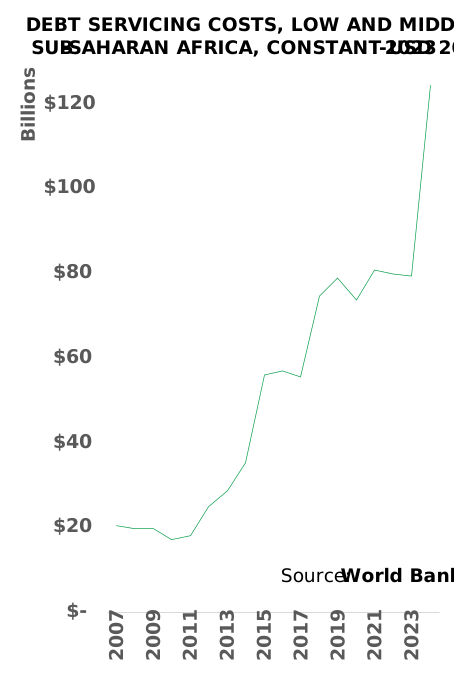
Annual debt servicing costs across low-and-middle income countries in sub-Saharan Africa have more than quadrupled in the last 12 years and are now over $120 billion a year. [1]
Sub-Saharan African governments spent $2.4 billion US dollars a week, and $300 million a day on debt servicing in 2024. [2]
This means sub-Saharan African countries are paying three and a half times more in debt servicing than the bilateral ODA they receive (even before the recent US and UK ODA cuts). [3]
The rest of the world takes far more from Africa than it contributes.
The $2.4 billion dollars a week is being paid from already small government budgets that are already a fraction of richer countries due to Tax injustice and historical injustices.
What has been the impact on African countries and Africans?
These debt payments are unaffordable and have an impact on the lives of young Africans that is critical for Africa’s future.
In Kenya for example, you can track the huge increase in malnutrition of six million more people in the last decade alone, with the colossal 650% rise of debt servicing costs [4].
In 2023 Kenya spent at least a third of its annual tax revenues on debt servicing [5] and the debt crisis is destabilising the country – youth protestors have been killed and a government of national unity has been formed.
It is not just Kenya, across Africa debt servicing has hugely increased dramatically; eight countries have a higher percentage rise than Kenya with five increasing by over 1,000% since 2011 (even after removing inflation). [6]
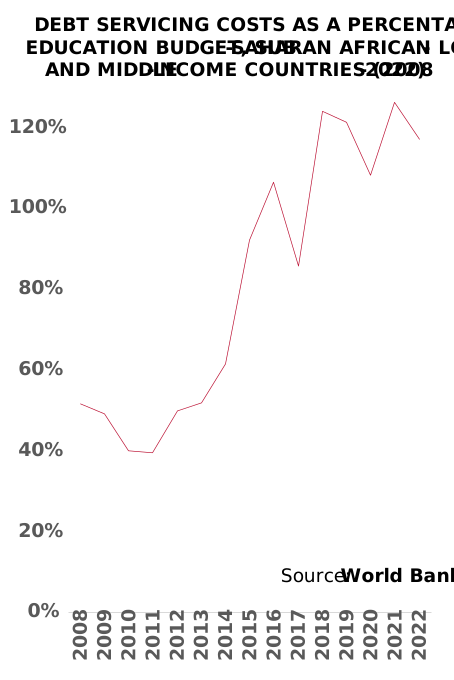
For example, since 2011 the ratio of government expenditure on debt to education has trebled in sub-Saharan African low and middle income countries to over 120% in 2022 and it will be over 170% when the data for 2024 is released.[7]
African governments are spending a higher percentage of their budgets on education than richer countries and the debt to education ratio is at least rising more slowly than the rise in debt servicing costs.
But however much African governments prioritise education, debt servicing on this scale still means deep education cuts.
Since 2012, 25 million more African children are out of school.
Yet since 2012, the GDP of the high-income countries who hold most of Africa’s debt has increased by $10 trillion [8].
In fact the debt servicing payments from Africa are only equivalent to 0.2% GDP of high income countries but they are devastating for Africa and Africa’s children [9]
How rich do wealthier countries need to become before they stop forcing Africa to pay them billions of dollars every month?
Aren’t All Countries Affected By The Debt Crisis?
Other regions have been affected, and the debt response must be applied to all affected low and lower-middle income countries, but it has unquestionably affected Africa the most.
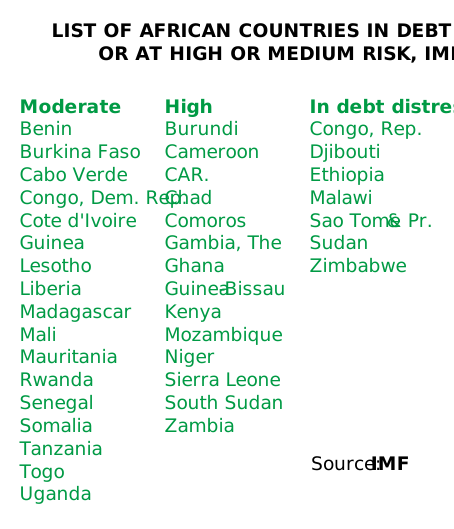
Of the nine countries the IMF themselves assessed as in debt distress (unable to pay their debts) in March 2025 seven are African and a majority of all of the countries at high or medium risk are African [10].
If you consider the debt crisis in terms of people affected the vast majority are African.
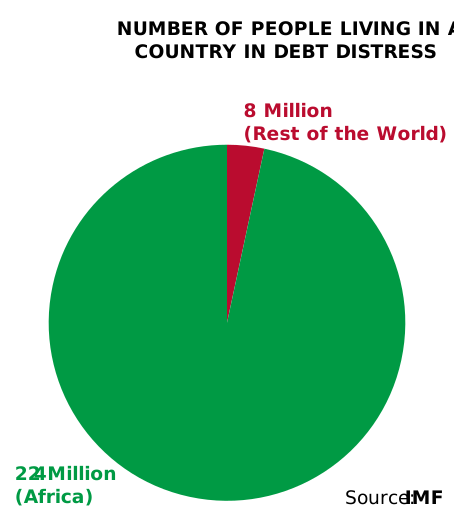
In fact, 97% of the 223 million people living in countries the IMF defines as in ‘debt distress’ in March 2025 are African [11]
This doesn’t even include countries like Kenya who are deemed at ‘high risk’ but not actually in debt distress yet despite the civil unrest and child services budgets being slashed.
Some 84% of the 824 million people living in countries the IMF defines as ‘high’ and ‘medium’ risk of debt distress are also African [11]
Some may ask if the debt crisis would be a bigger issue, and whether the world would be doing more non-Africans were being affected.
With over one hundred million African children growing up in countries where their government is effectively bankrupt [12] – is it any wonder there is a growing Africa Youth Divide?
Unfortunately, the Africa debt crisis carries on because so far, being assessed as in ‘debt distress’ in this crisis does not mean you will get help, far from it.
Many of the African countries in debt distress or at high risk have had this status for years as little is done about it. For example the average African country currently in debt distress has had the status for 7 years [13]. Many African children have spent their whole lives growing up in a country whose government is effectively bankrupt.
Forcing bankrupt countries to keep repaying unrepayable debt year after year is a form of debt slavery.
It is a problem right across Africa, 77% of all sub-Saharan African countries (and 70% of all African countries) are either now in debt distress or at high or medium risk. [14]
Isn’t This Because African Governments Borrowed More?
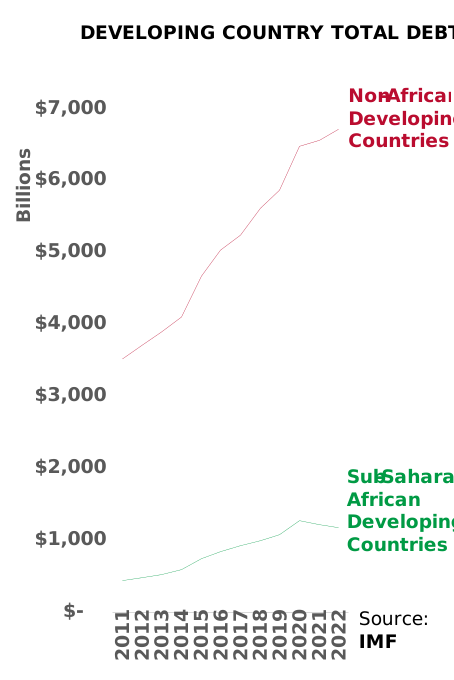
Given the debt crisis has affected African governments, you might think that African governments borrowed much more in recent decades.
However, the truth is governments in African developing countries borrowed less than other developing countries.
Debt increased across all developing countries, but it rose much faster outside of sub-Saharan Africa in total and per person. [15].
Due to the other historical and modern injustices, Africa’s GDP per person is lower than other regions, so in percentage terms some of the increases have been higher for African developing countries than others. However, even when calculated this way, it wasn’t that much higher in Africa.
When the crisis hit though, the worldwide spike in interest payments affected African countries first.
The market for government bonds closed up first in Africa and the impact on African government budgets was far greater.
The crucial reason why African countries are so affected by the debt crisis wasn’t the volume of their borrowing but that they were the hardest hit when the crisis started.
So what caused the debt crisis and why did it hit Africa the hardest?
Sources
1. & 2. World Bank ‘International Debt Statistics 2024’ – Get data here {Select on left hand side: Country – ‘Sub-Saharan Africa (excluding high income); Counterpart-Area – ‘World’; Series – ‘Debt service on external debt total (TDS, current US$)} shows $127,418,964,733 for 2024 and $40,741,394,673 for 2014 so they have increased by 312.75% in a decade (if converted to US Constant dollars using World Bank ‘sub-Saharan Africa excluding the ratio of high income’ GDP Constant and GDP Current data it still shows the costs have trebled). Dividing $127,418,964,733 by 52 shows sub-Saharan African countries are paid an average of $2.45 billion a week and over $300 million a day in debt servicing in 2024
3. OECD ‘Preliminary official development assistance levels in 2024’ – (16th April 2025) – Read more data here states “Preliminary estimates in 2024 show that net bilateral ODA flows from DAC members … to sub-Saharan Africa was USD 36 billion” & World Bank ‘International Debt Statistics 2024’ – Get data here {Select on left hand side: Country – ‘Sub-Saharan Africa (excluding high income); Counterpart-Area – ‘World’; Series – ‘Debt service on external debt total (TDS, current US$)} shows $127.4 billion for 2024. This means sub-Saharan African low and middle income countries paid three and a half times more in debt servicing payments than they received in bilateral aid in 2024.
4. Food and Agricultural Organization, ‘Indicator Number of undernourished people (millions)’ Get data here – gives 8.4 million for 2013 and 18.7 million for 2022 more than doubling & WORLD BANK’ GNI (constant 2015 US$) indicator NY.GNP.MKTP.KD’ – Get data here – and ‘Total debt service (% of GNI) DT.TDS.DECT.GN.ZS’ – Get data here give $553,071,267 for Kenya’s Debt Servicing costs in 2013 and $3,585,068,496 in 2023 an increase of 648%. This is the latest year the World Bank have published this data for but the situation has worsened since then – see [2]
5. Fitch Ratings ‘Kenya’s IMF Programme Halt Heightens External Financing Risk’ (27th March 2025) – Read more here – states Kenyan debt servicing costs are $5.4 billion in 2024 and the Kenya Cabinet Secretary for National Treasury and Economic Planning indicated in June 2025 (Read more here) that the debt servicing costs for the last year were $1.3 trillion KES (equivalent to $10 billion in June 2025). World Bank ‘Indicator Tax revenue (% of GDP) GC.TAX.TOTL.GD.ZS’ – Get data here – and ‘GDP (current US$) NY.GDP.MKTP.CD’ – get data here – give a Kenyan tax revenue estimate for 2024 of $15.1 billion so the Fitch Ratings estimate would mean around 36% of tax revenue was spent on debt servicing in 2024 and the Cabinet Secretary would mean around 65% of tax revenue.
6. World Bank GNI (constant 2015 US$) indicator NY.GNP.MKTP.KD’ – Get data here – and ‘Total debt service (% of GNI) DT.TDS.DECT.GN.ZS’ – Get data here give debt servicing increases in constant USD 2011 – 2023 shows 8 African countries have a percentage debt increase higher than Kenya (Guinea-Bissau, Senegal, Sierra Leone, Mozambique, Rwanda, Tanzania, Togo, Uganda). Five have increased by over 1,000%.
7. World Bank ‘International Debt Statistics 2024’ Get data here {Select on left hand side: Country – ‘Sub-Saharan Africa (excluding high income); Counterpart-Area – ‘World’; Series – ‘Debt service on external debt total (TDS, current US$)} gives debt of $28,818,155,505 for 2012, $83,466,392,258 for 2021 and $127,418,964,733 for 2024 & dividing by ‘Indicator GDP (current 2015 US$) NY.GDP.MKTP.KD’ Get data here – gives a % of debt to GDP of 1.7% for 2012, 4.3% for 2021 and a likely 6.2% for 2024 (final data not released yet for 2024) & ‘Indicator Government expenditure on education, total % of GDP SE.XPD.TOTL.GD.ZS’ – Get data here – gives 3.4% for 2012, 3.4% for 2021 and a projected 3.5% for 2024 (if anything an overestimate given recent education cuts). This creates a debt to education ratio of 49.8% in 2012, 126.2% in 2021 and will give around 175-180% for 2024.
8. UNESCO UIS ‘Out of School Estimates’ (Accessed June 2025) – Get data here – for Africa (sub-Saharan Africa plus North Africa) gives 96,740,000 for 2012 and gives 119,250,000 for 2024, an increase of 22,510,000 & . For the Rest of the World (World minus Africa) gives 186,800,000 for 2010 and 153,650,000 for 2024, a fall of 33,150,000 & World Bank ‘GDP (constant US$) NY.GDP.MKTP.KD’ – Get data here – gives for high income country GDP $46.96 trillion for 2012 and $57.81 trillion for 2023 (latest year) an increase of $10.85 trillion
9. World Bank ‘Indicator GDP (current US$) NY.GDP.MKTP.CD’ – Get data here gives GDP of $57.8 trillion for 2023 & World Bank ‘International Debt Statistics 2024’ Get data here {Select on left hand side: Country – ‘Sub-Saharan Africa (excluding high income); Counterpart-Area – ‘World’; Series – ‘Debt service on external debt total (TDS, current US$)} gives debt of $127,418,964,733 for 2024 so it makes up only 0.22% of GDP for high income countries
10. IMF ‘List of LIC DSAs for PRGT-Eligible Countries (31st March 2025)’ – Get data here – gives a list of countries by debt assessment & United Nations Data Portal Population Division ‘Population by 1-year age groups and sex’ {Add together ages 0-17} gives totals for children in each country for 2024 & World Bank ‘Indicator Population, total, SP.POP.TOTL’ – Get data here – gives total population for 2024. African countries in debt distress are Congo, Rep, Djibouti, Ethiopia, Malawi, Sudan, Sao Tome and Principe, Zimbabwe.
11. & 12. Using sources from [10] gives the Population of countries at debt distress by ranking and percentage of the total African countries gives 223,746,487 Africans living in a debt distress country (96.6% of the global total) and 106,103,396 African children growing up in a country in debt distress (97.4%) of the global total.
13. Debt Justice ‘Record of previous year’s IMF List of LIC DSAs for PGRT Eligible Countries lists’, See data here {Select Debt Data Portal and then select IMF Risk Ratings}
14. IMF ‘List of LIC DSAs for PRGT-Eligible Countries (31st March 2025)’ – Get data here – gives 37 sub-Saharan African countries and 38 African countries as in debt distress or at high or medium risk making 70.3% of African countries and 77% of sub-Saharan African countries.
15. IMF ‘Central Government Debt (Percent of GDP)’ Get data here & World Bank ‘Indicator GDP (constant 2015 US$ NY.GDP.MKTP.KD) ‘ Get data here give country debt increases then total African and non African developing countries & World Bank ‘Indicator Population, total, SP.POP.TOTL’ – Get data here – gives total population by year by country to get a per capita figure on the aggregate debt increases
Population of countries at debt distress by ranking and percentage of the total African countries are: Medium 431,781,200 (88.6%); High 261,824,988, (77.7%); Debt Distress 223,746,487, (96.6%). For the share of children living in a debt distress country: Medium 220,291,286 (89.7%); High 129,038,143 (78.8%); Debt Distress 106,103,396 (97.4%).
Justice for Africa
Justice for Africa: Don’t Cut Our Future is an African youth- and student-led global campaign demanding an end to this injustice.